

Description
Phoenix Journal of Social, Law, and Political Studies is an international peer-reviewed academic journal published by the Amerta Institute under the Yayasan Amerta Insan Unggul. The journal provides a scholarly platform for academics, researchers, policymakers, and practitioners to disseminate original and high-quality research in the fields of social sciences, law, politics, economics, and governance. It promotes interdisciplinary and multidisciplinary perspectives, covering areas such as social transformation, legal reform, human rights, public policy, democracy, political institutions, political economy, political sociology, international relations, socio-cultural dynamics, and sustainable development. All submitted manuscripts undergo a rigorous double-blind peer-review process to ensure originality, methodological rigor, academic integrity, and scholarly relevance. The journal is published three times annually, in January, May, and September, and is committed to advancing scholarly knowledge and fostering critical academic discourse on contemporary societal, legal, political, and economic issues.
List of Phoenix Journal Visitor Countries
Current Issue
Vol. 1 No. 1 (2026): January 2026
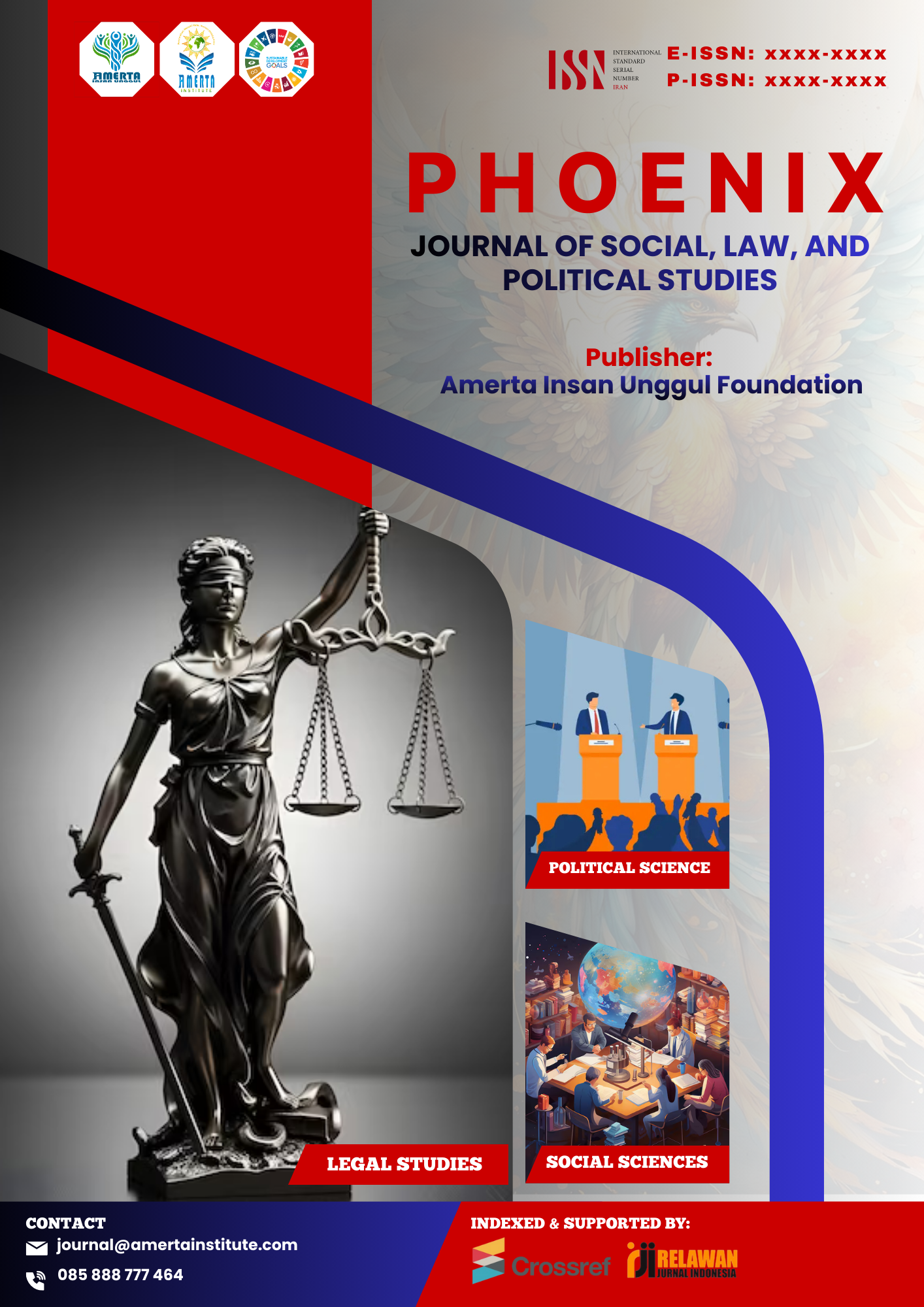
Phoenix Journal of Social, Law, and Political Studies, published by Amerta Institute, is a prestigious electronic academic publication dedicated to advancing research and knowledge in the fields of Economics, Management, and Accounting. It holds the Print Number International Standard Serial Number (P-ISSN) 0000-0000 and the Electronic Number International Standard Serial Number (E-ISSN) 0000-0000, ensuring the dissemination of high-quality scholarly content in the digital domain. Research in real estate, insurance, monetary theory and policy, and industrial organization is also welcomed. Editor in Chief: Nur Sandi Marsuni. Frequency: January, May, and September.
Published: 2026-01-17
Articles
Criminal Law Reform: Balancing Justice and Legal Certainty in the Development of Criminal Justice
1-14
The Role of Legal Sociology in Realizing Social
15-31
Factors Influencing the Occurrence of Criminal Offenses in Society
33-46
The Role of Legal Sociology in Advancing Social Justice in Society
47-60
Agrarian Conflict Dynamics and Their Implications for Natural Resource Governance in Indonesia
61-73
Publication Workflow

Scope and Focus
- Social Sciences: The journal covers a broad range of topics in social sciences, including sociology and social change, cultural studies and social dynamics, education and community development, communication and media studies, social welfare and public issues, as well as the impact of digital society and technological transformation. These areas aim to explore how social structures, cultural interactions, communication patterns, and technological advancements influence human behavior, societal development, and public life at local, national, and global levels.
- Law Studies: In the field of legal studies, the journal encompasses constitutional and administrative law, civil and criminal law, international law and human rights, business and economic law, cyber law and technology law, as well as environmental and sustainable law. This scope highlights the role of legal frameworks in regulating governance, protecting rights, supporting economic activities, and addressing emerging legal challenges in the digital era and sustainable development context.
- Political Studies: Within political studies, the journal includes political theory and political philosophy, public policy and governance, comparative politics, international relations, political communication, and democracy, elections, and political institutions. These topics aim to analyze political systems, institutional dynamics, policy processes, and global political interactions, providing insights into democratic practices, governance effectiveness, and contemporary political transformation.
- Economics: The journal welcomes research in economics, including economic development and growth, macroeconomics and microeconomics, public economics, international economics, development economics, monetary and fiscal policy, labor economics, regional and urban economics, environmental economics, digital economics, behavioral economics, Islamic economics, and political economy. This scope focuses on economic processes, institutions, policies, and interactions that shape economic development, resource allocation, market behavior, inequality, employment, sustainability, and societal welfare at local, national, regional, and global levels. Particular attention is given to interdisciplinary studies that examine the interaction between economic systems, political institutions, legal frameworks, and social structures.
List of Phoenix Journal Visitor Countries