
Description
The Eternia Journal of Education, Science, and Technology is a peer-reviewed, open-access journal published by the Amerta Institute under the auspices of Yayasan Amerta Insan Unggul. The journal is published three times a year, in April, August, and December, and serves as an international platform for disseminating high-quality scholarly research across interdisciplinary fields. The journal aims to facilitate academic dialogue, knowledge exchange, and collaboration among scholars, researchers, academics, and practitioners worldwide. It publishes original research articles, review articles, and applied studies in a broad range of fields, including education, educational technology, information systems, data science, biotechnology, health sciences, natural sciences, and applied sciences. Emphasizing innovation, methodological rigor, interdisciplinary perspectives, and practical relevance, all submitted manuscripts undergo a double-blind peer-review process to ensure academic integrity, scientific quality, and scholarly contribution. The journal is committed to advancing knowledge, encouraging interdisciplinary research, and promoting innovative and sustainable solutions to contemporary global challenges in education, science, and technology.
List of Eternia Journal Visitor Countries
Current Issue
Vol. 1 No. 1 (2026): April 2026
Published: 2026-04-17
Articles
The Influence of Job Design on Work Quality among ASN Employees in Pangkajene and Islands Regency
1-18
Transformational Leadership and Work Motivation Effects on Village Apparatus Performance: Evidence from Waekeccee Village, Bone Regency, Indonesia
19-39
The Role of Micro, Small, and Medium Enterprises (MSMEs) in Enhancing Employment Absorption in North Kolaka Regency
41-57
The Influence of Brand Trust on Online Purchase Intention in Enrekang Regency
59-75
The Influence of Incentives on Employee Performance at PT Perkebunan Nusantara XIV Makassar
77-92
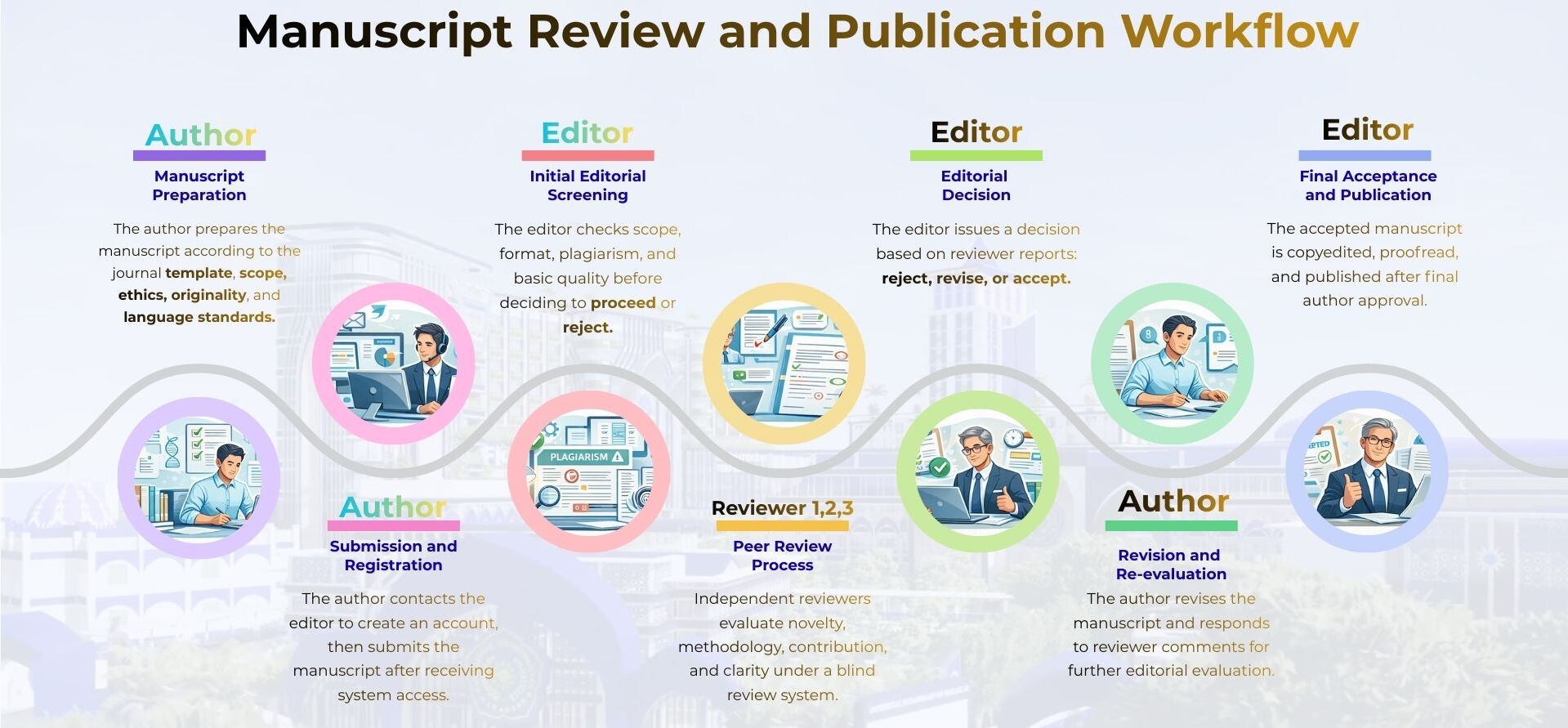
Publication Workflow
Scope and Focus
Education (All Fields of Education): The journal accepts research from all areas of education, covering both theoretical and empirical studies across diverse educational contexts. This includes, but is not limited to, curriculum and instruction, educational management and policy, higher education and vocational education, educational psychology and assessment, digital learning and educational innovation, STEM and non-STEM education, teacher education and professional development, as well as multidisciplinary and interdisciplinary education research that contributes to the development and transformation of educational practices at local, national, and global levels.
Science (All Areas of Scientific Research): The journal covers broad scientific disciplines encompassing both fundamental and applied research. Areas include natural sciences such as physics, chemistry, biology, earth science, and environmental science; applied and interdisciplinary sciences; mathematics and statistics; computational and experimental science; life sciences and health-related scientific studies (with a non-clinical focus); as well as emerging scientific fields and cross-disciplinary research that advance scientific knowledge and innovation.
Technology (General and Applied Technology): The journal welcomes research in all areas of technology and innovation that support scientific advancement and practical applications across sectors. This includes information and communication technology, artificial intelligence and data science, engineering and applied technology, software and system development, industrial and manufacturing technology, digital transformation and emerging technologies, and technology applications across various domains that demonstrate innovation, system development, or technological implementation.
Economics (All Areas of Economics and Economic Studies): The journal welcomes theoretical, empirical, applied, and interdisciplinary research across all areas of economics. This includes, but is not limited to, microeconomics and macroeconomics, monetary and fiscal economics, international economics and trade, development economics, public economics, labor economics, agricultural and environmental economics, industrial and regional economics, Islamic economics and Islamic financial management, financial economics, banking and capital markets, behavioral economics, econometrics and quantitative economic analysis, digital and creative economies, as well as contemporary economic issues related to globalization, sustainability, technological transformation, financial inclusion, and economic development at local, national, and global levels.